
Teddies Boldly Go Where No Bear Has Gone Before
ASTRO-TEDDIES RETURN SAFELY
Students from Parkside and Colleridge schools helped to launch four teddies wearing space suits that they had designed. The teddies reached an altitude of just over 30 km and their temperatures were logged throughout the flight to see how they fared in the extreme cold. The different spacesuit designs resulted in distinct difference in the temperatures of the teddies.
When the payload was launched, just after 11am, there were some fears that it might end up in the sea. But, with a very quick ascent, these fears were laid to rest and the payload landed 4 miles north-east of Ipswich. “For the first time ever we actually made it to the landing site in time to see the payload come down! At burst our prediction software provided us with an estimate that was less than 2 km from the actual landing site. We arrived in time to see a beautifully inflated parachute floating just a few hundred meters above our heads.”

The goal of the experiment was to determine which materials provided the best insulation against the -53 ° C temperatures experienced during the journey. Each of the bears wore a different space suit designed by 11-13 year-olds who were took part in the experiment. But the main goal of the endeavor was to give young students the opportunity to try their hand at a real mission in sending objects into space.
“We want to offer young people the opportunity to get involved in the space industry whilst still at school and show that real-life science is something that is open to everybody” says Iain Waugh, chief aeronautical engineer of student-run Cambridge University Spaceflight.
“High altitude balloon flights are a fantastic way of encouraging interest in science. They are easy to understand, and produce amazing results,” said Daniel Strange, treasurer of CU Spaceflight.
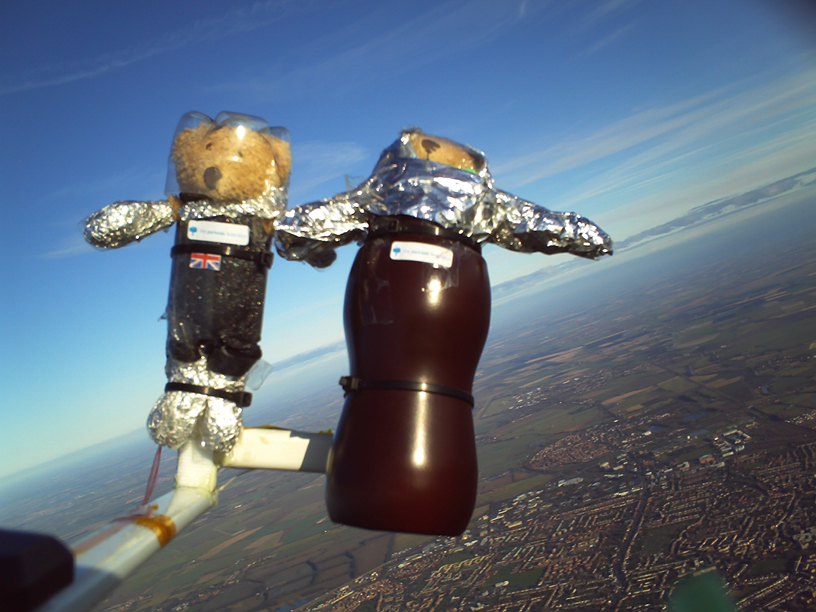
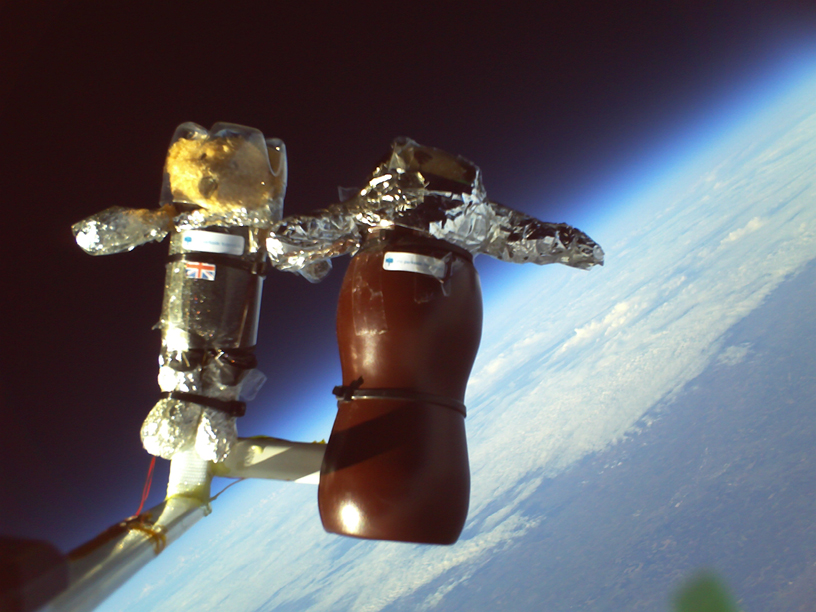
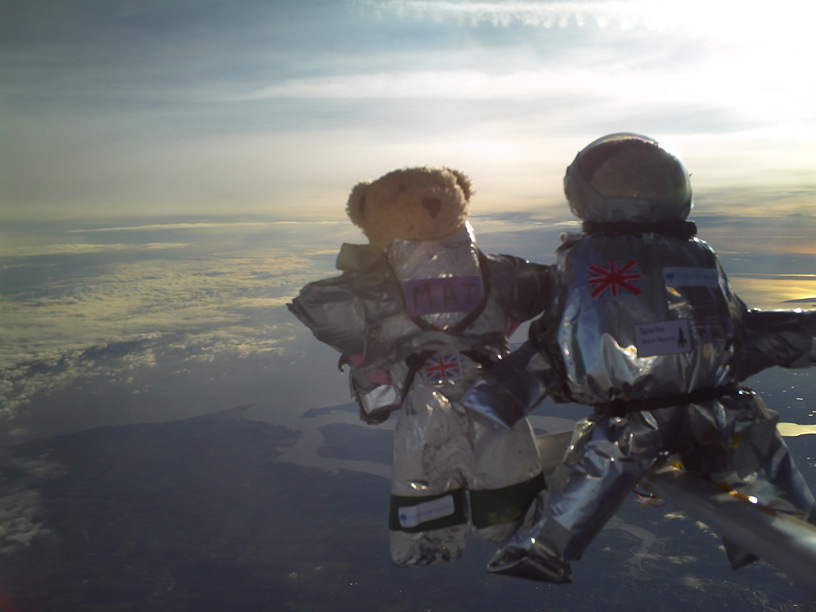

The payload which carried the bears was designed by CU Spaceflight and contained several cameras, a flight computer, GPS and a radio. During the 2 hour and 9 minute flight, the radio broadcasted the location of the payload to a chase team on the ground. The team predicted the landing site using wind speed data and arrived in time to see the payload and teddy bears drift slowly back down to earth by parachute.
CU Spaceflight is a student-run society aiming to reduce the cost of sub-orbital spaceflight. They have launched several payloads to near space on high-altitude helium balloons and are currently designing a system to launch a rocket from a balloon platform to outer space for under £1000 per launch.
They have run several outreach events and are currently holding the UK Space Challenge 2009, as part of the University of Cambridge’s 800th Anniversary. Twenty four teams of science students aged 14-18 are competing to design a scientific experiment that will be taken to near space on a high-altitude helium balloon.
SO AMAZINGLY COOL!!!
Visit Site: Cambridge University Spaceflight


 🎭
🎭 